A policy limit is the maximum amount an insurer will pay for covered loss under the applicable coverage part, subject to the policy wording.
Why It Matters
A policy can cover a claim and still leave the insured with a major uncovered balance if the loss exceeds the applicable limit. Limit structure is therefore one of the most important practical parts of any insurance program.
How It Works in Real U.S. Insurance Practice
Policies may use per-person, per-claim, per-occurrence, aggregate, combined single, or sublimited structures depending on the line of business. Some claims consume one limit; others erode an aggregate shared across many claims. Limits interact with deductibles, self-insured retentions, valuation rules, and defense-cost treatment.
The practical question is not just “what is the limit on the declarations page?” It is “which limit applies to this claim, and how much of it is still available after deductibles, prior claims, and narrower sublimits are considered?”
A common simplified payment view is:
Here, Net Covered Amount is the covered amount remaining after deductible and valuation rules are applied.
| Limit structure | What it caps | Why it matters in practice |
|---|---|---|
| Per-occurrence or per-claim limit | One claim or event | A single severe loss can exhaust it immediately |
| Aggregate limit | Total claims over the policy period | Earlier claims can leave less limit for later losses |
| Sublimit | Narrow category of loss or expense | A smaller cap can apply even when the main policy limit is much higher |
| Combined single limit | Combined bodily injury and property damage payment bucket | Common in auto and liability settings where one total limit governs the event |
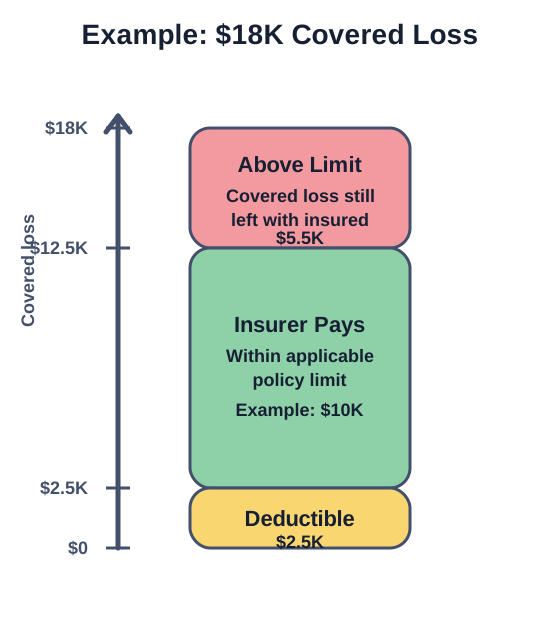
A covered loss can still leave the insured paying both the deductible and any amount above the applicable limit.
Practical Example
If a liability policy has a $1 million per-occurrence limit and a $2 million aggregate limit, one severe claim may use the full $1 million occurrence limit, while multiple claims across the year can continue eroding the $2 million aggregate.
Common Misunderstandings or Close Contrasts
- A higher limit does not broaden the causes of loss that are covered.
- Policy limit and limit of liability are often used interchangeably, although a form may use limit-of-liability wording for a specific coverage part or grant of coverage.
- Declared limits can be subject to sublimits for narrower categories of property or expense.
- “Enough insurance” depends on exposure size, not just a number that looks large on paper.
- The limit that matters for a claim may be lower than the broad headline limit shown on the declarations page.
Knowledge Check
If a commercial property policy has a strong insuring agreement but a low limit, can a severe covered loss still leave a business underinsured?
Yes. Coverage and limit are separate issues. A loss can be covered but still exceed the amount the insurer agreed to pay.